 |
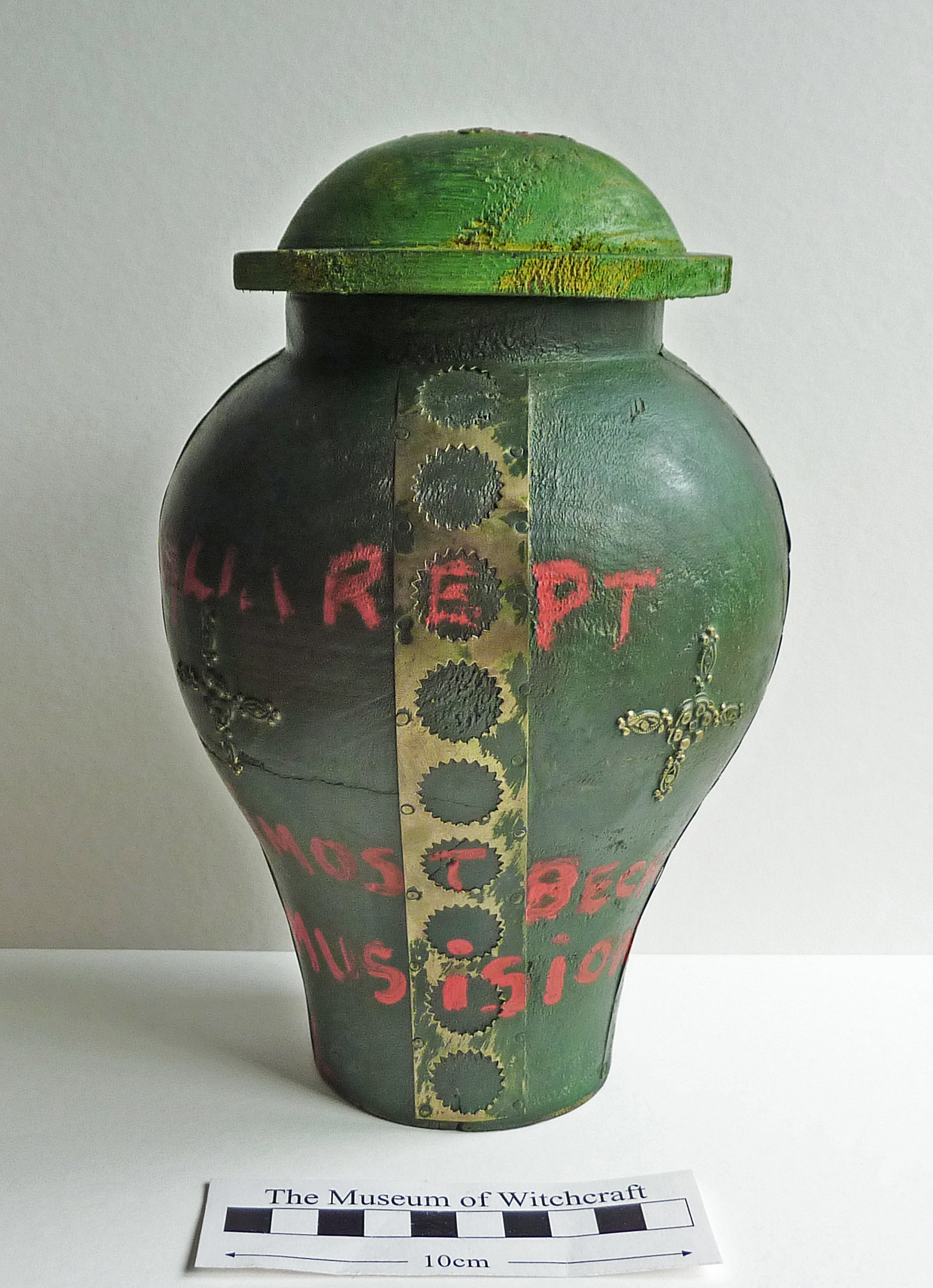
| Spirit pot made by Jake Stratton-Kent, photo from the Museum of Witchcraft |
Before diving in I wanna mention the work of Rufus Opus that I encountered researching for this post. I think he does a better job explaining this concept and it's origins than I could. He also provides a method of making your own, which isn't something I'm going to be getting into much.
Some of his blog and Youtube posts explaining goetic spirit pots:
"Working with spirit pots"
"More on spirit pots"
Goetic spirit pots
Spirit pots, witch bottles, and Brass vessels
"More on spirit pots"
Goetic spirit pots
Spirit pots, witch bottles, and Brass vessels
I will be speaking from my own perspective having encountered the idea of spirit pots from a magical tradition I was invited to explore, with inspiration from the work of Jake Stratton-Kent's work with the Grimorium Verum (who has some of his pots now on display at the Museum of Witchcraft. One can be seen above. 1,2,3), with a focus on the rite I found in the Book of Oberon.
This idea has it's roots in ATRs, and has spread into the wider ceremonial magic community. As some ATRs utilize grimoire magic, spirits, and seals. These different branches of magic mixing lead to the creation of this way of working goetic spirits through a permanent brass vessel. As shown by grimoire magicians like Jake Stratton-Kent, Rufus Opus, and Aaron Leitch. To paraphrase someone I met who practices from a tradition where they make true spirit pots, "Anyone can make a pot and put a spirit in it. It just wouldn't be a traditional (insert tradition) spirit pot."
[Note: I also wanna give a word of caution to anyone looking to research these spirit vessels further. As traditional spirit pots can be beautiful and gruesome. Containing animal parts, blood, bones, blades of various kinds, and more. These images can be jarring to some, so go into any research you do knowing you might encounter these things.]

So to quote Rufus "They Aren't Really "Spirit Pots"." These are spirits put in pots. And these pots are very comfortable spirit houses, or highly potent talismans. That is intended to be permanent or long lasting. So these spirit houses are made by including materia that aligns with the spirit you will hopefully be calling into the vessel. The vessel of choice should also be something that can seal, and if possible able to be marked with the desired spirit's seal.
Once a spirit is put into a pot, it becomes significantly more present in your life, as you are making them a permanent house here in your home. You can more easily access this spirit without grand rituals, and they can access you. There becomes less of a need for elaborate rites, as when someone has a spirit in a pot, they might just approach the vessel and speak to it when they're in need and give small offerings. Similar to the way someone might work with an enlivened statue.
I find that including blessed solomonic talismans is another potent option as well. Either using the whole charm, or by burning the talisman to ash and including that in the vessel. Putting in things like anti-witchcraft charms and such has also proven to be useful in a spirit pot for me. Once given to this spirit these worked objects becomes apart of them.
It's suggested to put grave dirt down first, then dirts that aligning with the realm the spirits operate in, and dirt from your local community or crossroads. Then a rock/stone over top. Followed by your other materia.
Making sure to awaken the spirit of each thing as you put it into the vessel, and having paid proper respects when gathering these things. As well as doing divination to make sure the spirit wants every object you intend you put in, this should be a clear Yes/No type of divination. This process of gathering materials during the proper planetary days and hours can take time, and it should. This is not a process to rush.
Once a spirit is put into a pot, it becomes significantly more present in your life, as you are making them a permanent house here in your home. You can more easily access this spirit without grand rituals, and they can access you. There becomes less of a need for elaborate rites, as when someone has a spirit in a pot, they might just approach the vessel and speak to it when they're in need and give small offerings. Similar to the way someone might work with an enlivened statue.
What Goes into a spirit pot/vessel:
Its common to find dirt, herbs, stones, bones, and other objects in these pots (I've seen cards, knives, flowers, chains, matches, dice, and more). Oil, fat, and blood are also sometimes used. As well as the spirit's seal. It is also sometimes suggested to write out the purpose of the spirit you're calling and including that in the vessel.I find that including blessed solomonic talismans is another potent option as well. Either using the whole charm, or by burning the talisman to ash and including that in the vessel. Putting in things like anti-witchcraft charms and such has also proven to be useful in a spirit pot for me. Once given to this spirit these worked objects becomes apart of them.
It's suggested to put grave dirt down first, then dirts that aligning with the realm the spirits operate in, and dirt from your local community or crossroads. Then a rock/stone over top. Followed by your other materia.
Making sure to awaken the spirit of each thing as you put it into the vessel, and having paid proper respects when gathering these things. As well as doing divination to make sure the spirit wants every object you intend you put in, this should be a clear Yes/No type of divination. This process of gathering materials during the proper planetary days and hours can take time, and it should. This is not a process to rush.
Making and Working a spirit pot:
The initial act of creation should be a grand one. Involving a full goetic rite. Rufus Opus gives a good praxis for this in the above videos. It's highly recommended to go through the act of casting a circle or hallowing your ritual space. I also suggest using a ritual knife during the rite, and wearing all white if possible (or another form of ceremonial garb).When calling and approaching the spirit come with respect, respect for yourself as a magician and respect for the spirit giving you their time. This will run counter to some other traditional approached to goetic magic, but this will bring you the best results. When making the vessel for the fairy queen in the Book of Oberon you see this difference in tone when compared to other operations in the text.
When the vessel has been assembled it becomes time to ask the spirit to enter the pot. Offer the spirit gifts of liquor, fire, and favorable incense, and inform it you will continue to provide these things if the spirit enters the vessel and works for you. Unless you receive some horrific sign telling you "no" then assume the spirit has gone inside. Give the spirit an initial task to prove it's here in the vessel, then give it 2 weeks to work before returning the vessel. Let it rest and do it's task, and only call the spirit back to you if you're certain something went wrong in how the spirit was sent out. If the spirit is called back, it's task clarified, and it still doesn't work than you're vessel may be empty. Though if you just keep providing offerings eventually a spirit will call it home. Also, consider a form of passive divination to look for signs of spirit as well.
Working a pot might be different than working a typical talisman or goetic spirit seal too. Within Oberon there are a few taboos you're supposed to observe, such as not asking the spirit it's name or whether it's a woman or fairy. To work with this fairy you're also supposed to anoint your eyes with an oil special to her. So the spirit being bound might have specific expectations for how they are to be worked properly. Divination or knowing a skilled diviner is helpful in this when a text isn't clear on how to best work with a spirit.
Some pots might need to be continually fed to work their best, this should be done sparingly. Small offerings of candles, incense, and liquor are okay to give when putting the spirit to work. Save food offerings, animal offerings, ect.. for special occasions or when the spirit has done a lot of unpaid work for you. A fat spirit is a slow spirit, so keep them fed but not satiated.
Thoughts on the nature of goetic spirits in this context:
My personal experiences with working spirits this way has lead me to believe that these spirits inhabit the world around us and beyond us. Goetic spirits frequently being spirits of place or necromantic spirits called into these names. Rufus Opus will frequently refer to them as "nature spirits" and I've seen other goetic magicians call them "elemental" or "directional" spirits. Showing an alignment with place/location.I compare this process of calling spirits by goetic titles to pinning a mask to a shadow. Spirits are happy to be known and receive offerings, and if someone is calling spirits under a certain name local spirits would be happy to fill that role. To no harm to the practitioner, in fact to their benefit. And maybe through this work the spirit will becomes more like the goetic name they're operating under.
As the way I and some see it is, if we both have a house for say Bune then my housed "Bune" may or may not be the same as your housed "Bune." My experience with Bune will be shaped by my environment, what I'm able to provide for him, what his house is made from, and more factors. Especially when you're using local dirt in a spirit house like this, this will impact the way Bune comes through to you through this vessel. Your Bune might come to you in the form of a teacher or wise parental figure, mine might come in a more devilish necromantic form. Both are "Bune", maybe different facets of one grand Bune, or maybe they're different more local spirits who both operate well through Bune's domain and name. Some food for thought before you go housing a goetic spirit.
Comments
Post a Comment